The Certified Safety Professional (CSP) exam is used to measure a candidate’s knowledge and skills necessary to work as a safety professional. This includes making risk assessments, evaluating safety procedures and protocols, investigating incidents, and more.
Click “Start Test” above to take a free CSP practice test!
CSP Exam Eligibility
To be eligible for the CSP exam, you must meet all of the following requirements:
- You must have at least a bachelor’s degree.
- You must have at least 4 years of safety experience with a depth of professional safety duties.
- You must have a BCSP-Qualified Credential.
List of acceptable credentials
- Associate Safety Professional (ASP)
- Graduate Safety Practitioner (GSP)
- Transitional Safety Practitioner (TSP)
- Certified Industrial Hygienist® (CIH®)
- Chartered Member of the Institution of Occupational Safety and Health (CMIOSH)
- Canadian Registered Safety Professional (CRSP)
- CP-12 Professional Certificate in Safety and Occupational Health, US Army Combat Readiness Center (ACRC)
- Certified Safety Engineer (CSE)
- Master in Occupational Safety and Health, International Training Centre of the International Labour Organization (ITC-ILO)
- NEBOSH National or International Diploma in Occupational Health and Safety
- Professional Member of the Singapore Institution of Safety Officers (SISO)
- Diploma/Certificate in Industrial Safety, as issued by the State Government Departments Boards of Technical Education, Government of India
CSP Exam Outline
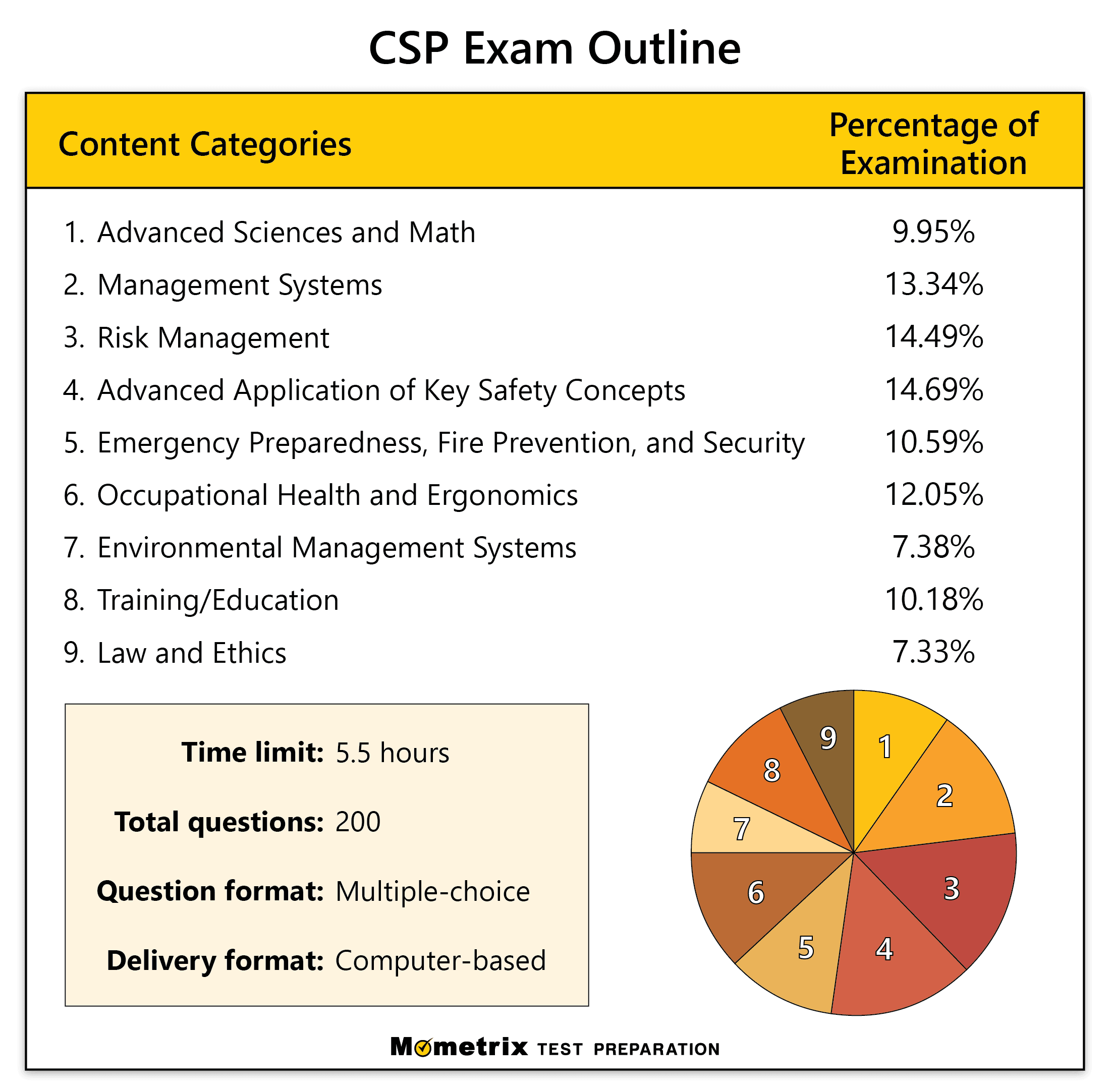
The CSP exam contains 200 multiple-choice questions, and you will be given a time limit of 5.5 hours.
The exam is split into nine content domains, and the questions in each domain are split into two categories: Skills and Knowledge.
1. Advanced Sciences and Math (9.95%)
The Knowledge questions in this domain evaluate the following:
- Anatomy and physiology concepts
- Chemistry and physics concepts
- Basic mathematics
- Statistics
- Methodology for research
- Microbiology
The Skills questions in this domain test your ability to calculate statistics from various sources of data and calculate requirements for hazardous material storage.
2. Management Systems (13.34%)
The Knowledge questions in this domain evaluate the following:
- Business continuity and contingency plans
- Concepts and techniques of project management
- Performance standards
- Incident investigation techniques
- Document retention principles
- Types of leading and lagging safety and security performance indicators
- Measuring and improving organizational culture
- Budgeting techniques
- System safety analysis techniques
The Skills questions in this domain test your ability to do the following:
- Perform gap analyses
- Analyze and interpret data
- Develop and sustain health management systems
- Evaluate and analyze survey data
- Use financial calculations to demonstrate business need
- Conduct casual factors analyses
- Apply management principles of responsibility, authority, and accountability
3. Risk Management (14.49%)
The Knowledge questions in this domain evaluate the following:
- Risk management processes
- Risk analysis
- Principles of insurance/risk transfer
- Hazard identification methods
- Costs and benefits of the risk assessment process
The Skills questions in this domain test your ability to do the following:
- Prioritize risk management options by applying risk-based decision-making tools
- Conduct hazard analyses and risk assessments
- Explain risk management concepts and options to stakeholders and the public
- Calculate metrics for organizational risk
- Select risk treatments or controls using the hierarchy of controls
4. Advanced Application of Key Safety Concepts (14.69%)
The Knowledge questions in this domain evaluate the following:
- Redundancy systems
- Human performance
- Personal protective equipment
- Fleet safety principles
- Common workplace hazards
- Materials handling
- Foreign material exclusion
- Principles of safety through design and inherently safer designs
- Facility life safety features
- Sources of information on hazards and risk management options
- Transportation safety principles
- Engineering controls
- Administrative controls
- Tools and equipment safety
- Multi-employee worksite issues
- Chemical process safety management
The Skills questions in this domain test your ability to do the following:
- Identify relevant signs, labels, and warnings
- Calibrate and maintain data logging, monitoring, and measurement equipment
- Interpret specifications, process flow diagrams, plans, and technical drawings
5. Emergency Preparedness, Fire Prevention, and Security (10.59%)
The Knowledge questions in this domain evaluate the following:
- Fire prevention, suppression, and protection systems
- Workplace violence and prevention techniques
- The transportation and security of hazardous materials
- Emergency and disaster response planning
The Skills questions in this domain test your ability to manage active incidents.
6. Occupational Health and Ergonomics (12.05%)
The Knowledge questions in this domain evaluate the following:
- How to evaluate occupational exposures
- Epidemiology fundamentals
- Principles of advanced toxicology
- Employee substance abuse
- Carcinogens
- Occupational exposure limits
- How to control occupational exposures
The Skills questions in this domain test your ability to do the following:
- Use sampling equipment
- Conduct exposure evaluations
- Interpret data from exposure evaluations
7. Environmental Management Systems (7.38%)
The Knowledge questions in this domain evaluate the following:
- Sustainability principles
- Environmental pollution prevention methods
- Registration, authorization, evaluation, and restriction of chemicals
- Waster water treatment plants
- Public water systems
- How released hazardous materials migrate and interact through the air, soil, surface water, and water table
- Onsite waste water treatment plants
The Skills questions in this domain test your ability to conduct hazardous waste operations by using appropriate waste management practices.
8. Training/Education (10.18%)
The Knowledge questions in this domain evaluate the following:
- Determining training program effectiveness
- Effective presentation techniques
- Education and training methods and techniques
- Training, qualification, and competency requirements
The Skills questions in this domain test your ability to do the following:
- Develop training programs and materials
- Conduct training
- Perform training needs assessments
- Develop training assessment instruments
- Assess training competency
9. Law and Ethics (7.33%)
The Knowledge questions in this domain evaluate the following:
- BCSP Code of Ethics
- Legal issues
- Workers’ compensation
- Standards development processes
- Protection of confidential information
- Labor and management
- Ethics related to conducting professional practice
The Skills questions in this domain test your ability to do the following:
- Interpret laws, regulations, and consensus codes
- Apply concepts found in the BCSP Code of Ethics
Check out Mometrix's CSP Study Guide
Get practice questions, video tutorials, and detailed study lessons
Get Your Study Guide
CSP Exam Registration
To register for the CSP exam, you must first create an online BCSP account. Through your account, you can then select “CSP” as your certification of choice and fill out the application. You will be asked to provide your contact information, proof of your BSCP-qualified credential, and your experience and education information. Once the application is filled out, you will need to submit it along with the $160 application fee.
Once your application is approved, you will have a full year from the date of approval to register and sit for the exam. During registration, you will need to pay the exam fee of $350. You can schedule your exam at any time with Pearson VUE.
Test Day
You should arrive at the testing location at least 30 minutes prior to the start of the test. Bring your examination permit and a valid government-issued photo ID. It is crucial that the name on your ID and the name on your exam permit match.
You must present your photo ID to the proctor when you arrive. After that, you will be photographed and asked to sign a roster and other rule forms.
Any personal items should be left at home or locked in your car because they are not allowed in the testing room. All electrical devices, including cell phones, are prohibited.
Just before the exam starts, you will receive a brief tutorial on the testing system, as well as the on-screen calculator.
How the CSP Exam is Scored
BCSP uses the Modified Angoff method and the Bookmark Standard Setting method to establish the scores for the CSP exam. Using these methods ensures that your score is based entirely on your testing performance and does not rely on how well other test-takers performed.
You will get your results immediately after completing the exam. As long as you achieve the minimum cumulative score for the entire test, you will have passed, even if you did not pass all nine domains individually.
Even though you don’t need to pass each individual domain, your score report will show you how you performed on each one. This is useful for understanding your strengths and weaknesses, especially if you did not pass and need to retake the exam. Currently, the minimum passing score is 140 out of 200.
Check out Mometrix's CSP Flashcards
Get complex subjects broken down into easily understandable concepts
Get Your Flashcards
FAQs
Q
How long is the CSP exam?
A
The time limit for this exam is 5.5 hours.
Q
How many questions are on the CSP exam?
A
There are 200 multiple-choice questions on the exam.
Q
What is the passing score for the CSP exam?
A
To pass the exam, you must answer 140 of the 200 questions correctly.
Q
How much does the CSP exam cost?
A
The examination fee is $350, which does not include the additional $160 application fee.